Welcome!
You have been invited to complete our Ability Test, a tool used to measure different forms of problem-solving ability.
The purpose is to gain a better understanding of how you approach and solve different types of challenges.
Our diffirent test variants
The Ability Test consists of several subtests that measure different kinds of logical and analytical thinking. You will complete one or more of the following tests:
Diagrammatic Reasoning
The ability to see relationships and patterns between objects.
Numerical Reasoning
The ability to understand and interpret relationships between numbers.
Spatial Reasoning
The ability to mentally rotate and manipulate three-dimensional shapes.
Verbal Reasoning
The ability to understand and identify relationships between words.
What Does It Mean That the Test Is normbased?
The test is norm-based, which means that your result is compared to a larger reference group. In this way, we can see how your performance compares with other individuals who have a similar background.
This provides a fair and objective picture of your ability and is used as one of several inputs in a recruitment or development process.
Why Do You Take the Test?
The results help to create a more complete picture of your strengths and development areas.
The test is not decisive on its own. It is always used together with other methods, such as interviews and personality assessments.
How the Test Works
The test consists of 2–4 parts, where each part takes about 8 minutes.
You can choose to take a short break between parts if needed.
A countdown timer is visible at the top of the screen.
The test ends automatically when the time is up, or when you choose Finish.
Work as quickly and as focused as you can.
If you are unsure about an answer, choose the option that seems most reasonable and move on.
You can move back and forth between questions and change your answers while the test is running.
The questions become gradually more challenging as you progress.
The goal is to answer as many questions correctly as possible within the given time.
Remember!
The test is only one part of the overall picture. Do your best, and see it as an opportunity to show how you handle different kinds of challenges.
For the Best Possible Conditions
Sit in a quiet place where you won’t be disturbed.
Have paper and pen nearby for notes.
Example Tasks and Tips
Diagrammatic Reasoning:
Tips for Figure-Based Tasks
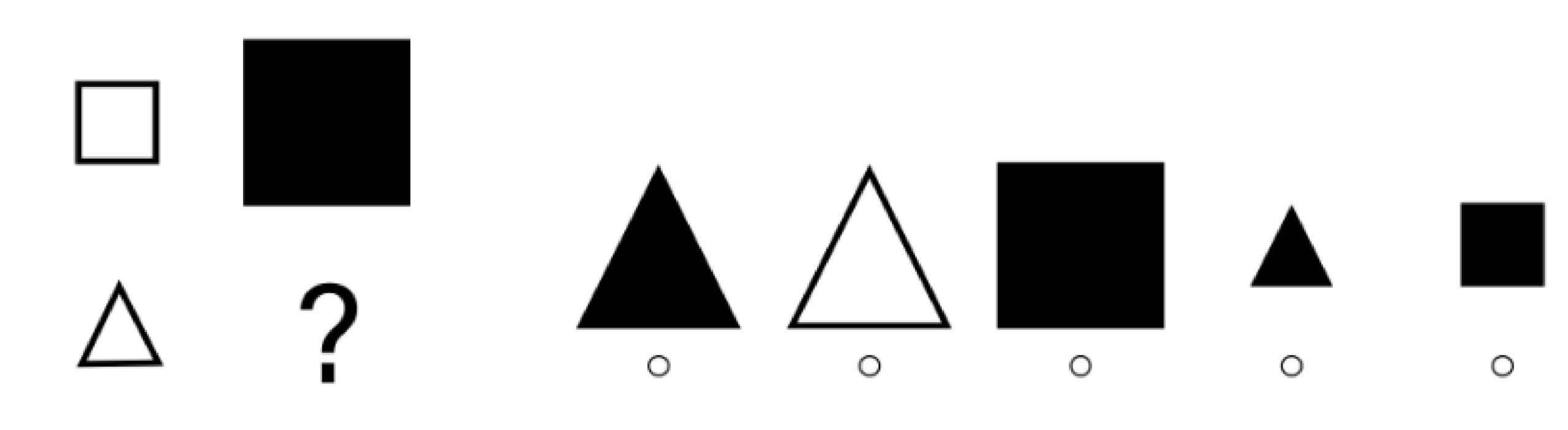
In this test, figures are presented in a series, and your task is to work out which option logically comes next. The figures can change in different ways, for example:
Size – they become larger or smaller.
Position – they move or change place.
Lines – the thickness of lines can change.
Shading/filling – the inside of the figure may be shaded or altered in some way.
Look carefully at the pattern and the logic in the changes to find the most reasonable next step.
In the example, the correct answer is: 1.
Diagrammatic Reasoning is about the ability to see patterns, relationships and logic in information – even when it is presented in an abstract way. It is a skill many people use more often than they think:
In everyday life, it can be about understanding how different factors are connected – for example, planning a trip, interpreting instructions, or solving practical problems.
At work, it might involve analysing processes, understanding workflows, interpreting schedules, or spotting patterns in data and reports.
Being able to quickly detect relationships, connections, and sequences makes it easier to make well-founded decisions and to anticipate what might happen next.
This ability helps you to structure complex information, see the big picture, and at the same time understand the details.
Tips for Numerical Patterns
Numerical Reasoning tasks, you are often presented with a series of numbers. Your task is to find the rule that governs the series and calculate the next logical number. Here are some common examples:
Addition (+)
Example: 2 – 4 – 6 – 8
+2 +2 +2
Each time, two is added to the previous number.
Next number will be: 8 + 2 = 10
Subtraction (-)
Example: 15 – 13 – 11 – 9
-2 -2 -2
Each time, two is subtracted.
Next number will be: 9 – 2 = 7
Multiplication (×)
Example: 3 – 9 – 27 – 81
×3 ×3 ×3
Each number is multiplied by three.
Next number will be: 81 × 3 = 243
Division (÷)
Example: 81 – 27 – 9 – 3
÷3 ÷3 ÷3
Each number is divided by three.
Next number will be: 3 ÷ 3 = 1
Always look at the difference between the numbers and check whether it’s the same rule, an increasing/decreasing change, or two different series that alternate.
In numerical reasoning questions, your task is to find the pattern that explains how the numbers change. Some common variants are:
Example: 1 – 3 – 5 – 7
+2 +2 +2
Each time, two is added to the previous number.
Next number is: 7 + 2 = 9
Example: 1 – 3 – 7 – 15
+2 +4 +8
(The pattern is that the increase doubles each time)
Next number is: 15 + (8 × 2) = 15 + 16 = 31
Example: 1 – 4 – 7 – 10
+3 +3 +3
Each time three is added.
Next number is: 10 + 3 = 13
Example: 2 – 200 – 5 – 300
First series: 2 → 5 (+3) → next is 8 (+3 again).
Second series : 200 → 300 (+100) → next is 400 (+100 again).
The two series alternate.
Numerical Reasoning is about understanding, interpreting and analysing number-based information. This ability is used widely:
In everyday life, for example when comparing prices in a store, calculating discounts, making a budget, or analysing household expenses.
At work, it can involve interpreting reports, analysing financial figures, understanding percentage changes, or checking calculations for accuracy.
This ability makes it easier to make well-founded decisions, identify trends, and ensure that work is based on facts.
Numerical ability is about understanding, interpreting and analysing numbers.
Spatial Reasoning
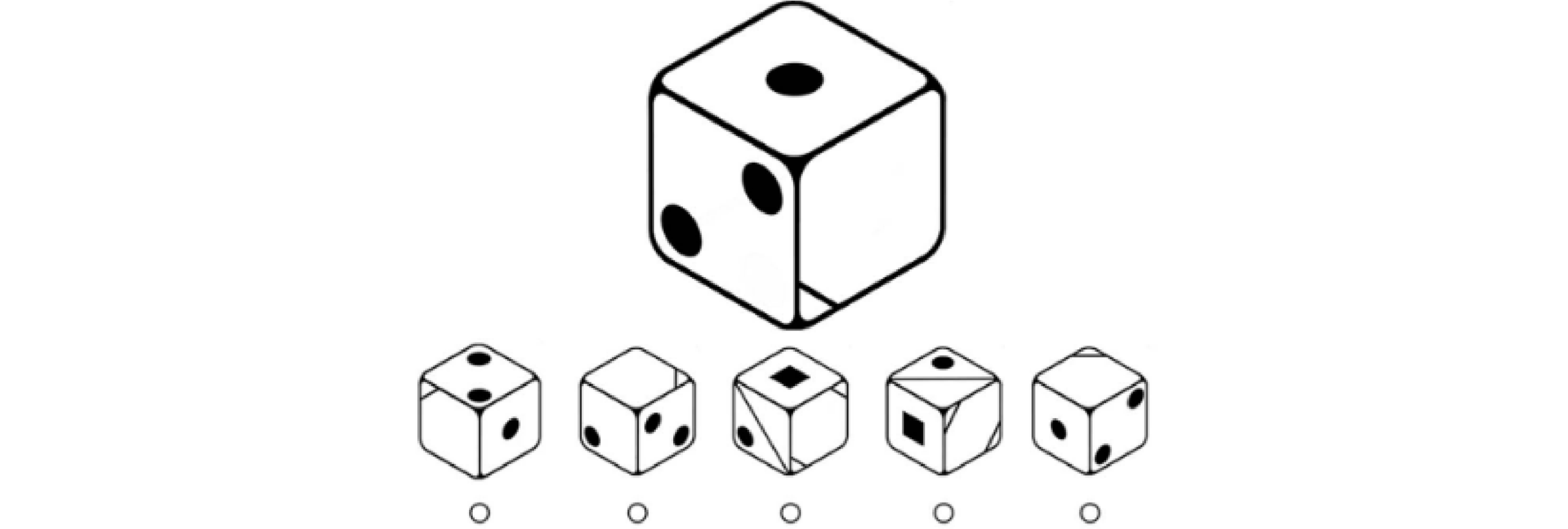
Spatial Reasoning is the ability to mentally rotate and manipulate three-dimensional shapes, such as a die.
In the example (illustration) to the right, the correct answer is 1. The die has been rotated clockwise and then backwards.
Work quickly using elimination: First remove options that are clearly impossible, select the best candidate, move on, and return later if you have time.
Lock a corner: Choose one corner and follow it through the rotations.
Spatial Reasoning is about being able to imagine and handle shapes, surfaces and objects in two or three dimensions. It is central in many situations:
In everyday life, you use it when reading maps, planning how to arrange furniture in a room, or packing a suitcase.
At work, it is important when interpreting technical drawings, planning process flows, doing design work, or when you need to visualise solutions to problems.
This ability helps you think creatively, understand structures, and see how different parts fit together into a whole.
Spatial ability is about being able to visualise and handle shapes and surfaces.
Verbal Reasoning
The ability to understand and identify relationships between words. You are given two statements that are both true. Based on these, you choose the alternative that best follows.
Example 1
All travellers have a ticket.
Some tickets are digital.
All travellers have a digital ticket.
All tickets are digital.
Some travellers have a ticket that is digital.
No traveller has a paper ticket.
Here, alternative C is correct.
Example 2
All available summer cottages are in the countryside.
Some available summer cottages have a bathing lake.
All summer cottages in the countryside are available.
Some summer cottages in the countryside have a bathing lake.
Some summer cottages in the countryside have a garden.
All summer cottages in the countryside have a bathing lake.
Here, alternative B is correct.
Verbal Reasoning is about understanding, interpreting and drawing conclusions from verbal information. It is a central part of both everyday communication and working life:
In everyday life, you use it when reading news, interpreting agreements, understanding instructions, or expressing yourself clearly in writing or speech.
At work, it is crucial for analysing reports, absorbing important information, evaluating arguments, or communicating in a clear and convincing way.
This ability makes it easier to quickly identify what is most important, understand nuances in language, and express yourself precisely.
Verbal ability is about understanding and using verbal information – a key to interpreting, analysing and communicating effectively in both everyday life and at work.
Our Different Test Variants
The Ability Test consists of several subtests that measure different kinds of logical and analytical thinking. You will complete one or more of the following tests:
Diagrammatic Reasoning
The ability to see relationships and patterns between objects.
Numerical Reasoning
The ability to understand and interpret relationships between numbers.
Spatial Reasoning
Förmågan att mentalt rotera och hantera tredimensionella former.
Verbal Reasoning
The ability to mentally rotate and manipulate three-dimensional shapes.